Showing posts with label Spelling. Show all posts

Tuesday, May 21, 2013

Reading and Spelling Difficulties: 7 Main Causes


Here is a guest blog by my friends at Easyread.  Enjoy, Erica

By David Morgan

It is estimated that up to 10% of the general population struggles with dyslexia. Some studies call that a conservative estimate, with many more people struggling to read and spell.

Many parents of dyslexic children or dyslexic adults find themselves in this situation, armed with a label but no real solution. Some feel it means that their child will never come to love reading. With the right help that is almost certainly not the case!

Reading is a neurological process that the brain undertakes every time it is presented with text on the page. In order to target the primary cause of reading difficulty to find a solution, we have to look at different areas where that process can break down.

There are seven main causes of reading and spelling difficulty that we have found to date. If you or someone you know is dyslexic, see if any of them match up with what you experience.

1. Optilexia - The main sign of Optilexia is guessing when reading, particularly with the short words. Sometimes the longer words seem easier and the reader will read a word without a problem on one page, but not the next. Spelling in free writing is atrocious, but the Optilexic can usually perform well on a spelling test. Unfamiliar words and place names will feel very difficult. The underlying cause of Optilexia can be found in how the learner is processing the text visually rather than aurally. Once that has been switched, a steady rate of progress can be gained.

2. Eye-Tracking Weakness - Does your child skip words and lines? Do single words seem easier than sentences and paragraphs of text? Normally a reader's eyes perform a refined jump from word cluster to word cluster left to right, called a saccade. Some struggling readers have weakness in the neural feedback loops controlling the eye muscles that control this movement. That makes focusing accurately on a word in a sentence very hard. The right simple eye-tracking exercises usually fix this neural weakness in just days.

3. Irlen Syndrome - Has your child ever complained about the words moving around on the page? The human eye has a great visual sensitivity to changes in color and brightness in order to identify patterns. However, some struggling readers have an over-sensitivity to black text on white background, which causes the words to shimmer or move around on the page. This can be alleviated with colored films to soften the level of contrast.

4. Memory Difficulties - Memory plays a big part in the reading process. Not only does the person have to remember each sound when decoding a word, but then multiple words need to be remembered for a sentence, then sentences remembered to comprehend a paragraph. People with short-term memory challenges have great difficulty retaining all this information when reading. Short-term memory difficulties have very distinct symptoms. In reading this can show up as poor comprehension, stilted reading flow and difficulty remember phonemes when sounding out a long word. In life this can show up as inability to remember multi-step directions, inability to remember lists of items and being generally forgetful of recent events.

5. Attention Deficit - Have you seen your child struggling to focus on the task of reading? Fidgeting? Easily distracted? I am sure you know why reading is harder than it should be. However, I am also sure you have seen your child happily focusing for long periods on some tasks; ones that seem enjoyable! That is the key to fixing this issue. Make reading fun with games.

6. Fluency Block - Does your child decode words competently, but struggle to read fluently? A conventional reader uses a part of their brain called the letterbox cortex to recognise common letter groupings. Amazgainly you aer able to raed scarblmed txet quite flnuetly, due to this function. Some struggling readers bypass their letterbox cortex when reading, instead using visual memory to store letter groupings. This causes the reader to be able to decode quickly but never really develop any fluency or smoothness. To fix this tricky problem means engaging this very specialist bit of cortex in the decoding process. We do that with anagrams.

7. Stress Spirals - Reading is a higher brain function and is therefore controlled by the frontal cortex. When the brain is under stress, 70% of the frontal cortex energy is diverted to the fight or flight center (amygdala) and the brain loses its capacity to think clearly. A child who struggles with reading is in a state of stress when trying. This sets the child up for inadequate mental resources when attempting to read. The pattern of being under stress and getting more stressed when trying creates a downward stress spiral which often results in meltdowns, tears and finally giving up.

A dyslexic reader may have one or several of these causes of difficulty. The key to making reading or spelling easier is to identify the cause and then find ways to address it. That is what we specialize in at Easyread.

Looking for a phonics program to help your struggling learner? Easyread incorporates solutions to these causes that may be due dyslexia, auditory processing disorder or highly visual learning styles. www.morganlearning.com 

Dr. Erica Warren is the author, illustrator and publisher of multisensory educational materials at Good Sensory Learning and Dyslexia Materials.  She is also the director of Learning to Learn, in Ossining, NY.  To learn more about her products and services, you can go to www.goodsensorylearning.com  www.dyslexiamaterials.com and  www.learningtolearn.biz 

Follow on Bloglovin

Saturday, March 9, 2013

Free Reading and Spelling Game for the TCH or CH, DGE or GE, CK or K Rules


The English language is packed with confusing rules that can make decoding and reading difficult tasks to master.  What's more, many of the workbooks and activities are boring, and even if students complete the lesson, it doesn't mean that they can apply the content in a different learning situation.  However, presenting the same content in a game-like format can make a lesson memorable and engaging even for struggling learners.

Here is a fun game that my students love to play.  It's great for literacy centers or reading centers, and it will also assist students with spelling.


Materials:

  • 1.5 -2.0 hole punch or round object that can be traced
  • Craft paper
  • Laminating sheets and laminator or 
  • Round wooden discs from the craft store and glue
  • Playing cards:  You can purchase blank playing cards on Amazon:  see link at the bottom, or use laminated craft paper and then write the letters on the blank side with a permanent marker.
How to make the game - using TCH and CH:
  • Place the word beginnings onto playing cards.  I make a stack of at least forty cards.  Twenty cards should illustrate the beginning of TCH words such as MA, WI, DU, and STI. The other twenty cards should illustrate the beginning of CH words such as MUN, HUN, BEA, and BEL.  Many lists can be found on the internet.
  • Make the spinning disc with the two word ending options on either side.  You can glue craft paper and colorful letters onto wooden discs, or glue two, thick, round pieces of craft paper together and laminate.
Instruction:
  • Teach the students the spelling rule:  TCH is usually used after a short vowel sound, and CH comes after a consonant or long vowel sound.
  • Teach the students the spelling rule:  DGE is usually used after a short vowel sound, and GE comes after a consonant or long vowel sound.
  • Teach the students the spelling rule:  CK is usually used after a short vowel sound, and K comes after a consonant or long vowel sound.
How to play:
  • At the beginning of each turn, the player spins the round disc with the word endings on them.  Hold the disc with one finger as illustrated and flick the edge with another finger.   
  • When the disc falls to the table, select a card with the word beginning.
  • Put the word beginning and word ending together to see if it forms a word with the correct spelling.  
  • If it does, the player gets to keep the card.  If not, the card is returned to the bottom of the stack. 
  • The winner is the first player to collect 10 cards.
If you would like to learn about some of my other popular reading games, go to: http://goodsensorylearning.com/reading-games.html  There, you can even download another fun, free game for learning the short vowels! 

I hope you enjoy this game.  I would love to hear you thoughts.

Cheers, Erica

Dr. Erica Warren is the author, illustrator and publisher of multisensory educational materials at Good Sensory Learning and Dyslexia Materials.  She is also the director of Learning to Learn, in Ossining, NY.  To learn more about her products and services, you can go to www.goodsensorylearning.com  www.dyslexiamaterials.com and  www.learningtolearn.biz 
Follow on Bloglovin

Saturday, February 16, 2013

Language Arts Letter Cubes: Fun Literacy Center Freebie

I love to use foam blocks for all sorts of language arts fun. Most recently, I created a game that my students adore. Here are the steps so you can create it too.

1) You can purchase colorful foam cubes on Amazon for a very reasonable price.  I included a link at the bottom of the post.

2) Select 12 cubes and with a permanent marker add the vowels and consonants as suggested in the table below.

3) Assign the point value on the bottom right hand corner.  This will also help the players to orient the letters.  For example, the letter M will look like the letter W when it is upside-down but as long as the number indicating the point value is in the bottom right hand corner, players can recognize that they need to rotate the letter to the proper orientation.  Also, using capital letters helps with letter confusion.

4) Other items needed to play:  

  • a timer 
  • a set of 12 colored cubes with the letters and point values for each player.

5) How to Play:  

  • Each player rolls a set of 12 colored cubes onto his or her playing area (players can not change the orientation of the cubes but must use the letters rolled).  
  • Set and begin the timer for 2-5 minutes.  You can decide on the amount of time you prefer.
  • Words must crisscross or join like a scrabble game, and players must try to use as many cubes as they can.  Like Scrabble, proper names and abbreviations can not be used.
  • When the timer goes off, the round ends and players add up their points as indicated on the cubes for each word created.
  • Bonuses are granted as follows:
    • 4 points for a 6 letter word
    • 5 points for a 7 letter word
    • 6 points for a 8 letter word
    • 5 points for using all 12 cubes
  • The winner is the player with the highest score after 5 rounds
If you would like to learn about some of my other popular reading games, go to: http://goodsensorylearning.com/reading-games.html  There, you can even download another fun, free game for learning the short vowels! 

If you like this or have any other ideas, please share your thoughts!!
   Enjoy, Erica

Saturday, February 9, 2013

Learning Center Ideas: Free, Fun Phonics Activities


It’s wonderful when giggles of joy and excitement ring through the classroom as young students eagerly learn the skills needed to be proficient readers.   Learning centers or reading centers are often the place where this can happen, but the trick to tickling your students attention often lies in multisensory, interactive activities or games. 

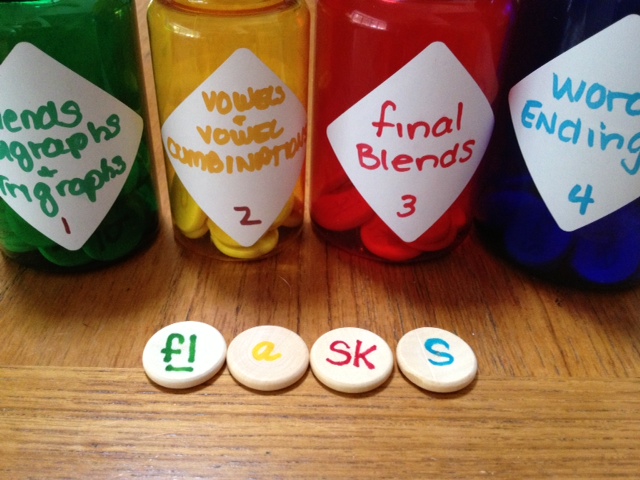
Here is a fun phonemic awareness activity I designed that you can make with old recycled pill or vitamin containers and other common household goods.  It’s a wonderful learning center idea that will help students blend phonics sounds into words.


   1)   Collect and clean old vitamin or pill containers. I like to use the clear, colorful ones.
   2)   Decide upon the playing pieces.  I use a 1 inch hole puncher with thick cardstock, large lima beans, or wooden craft discs. 
   3)   Place consonants, blends, digraphs, word endings or more onto both sides of the playing pieces.  I like to color code the pieces to match the color of the container so that clean up is quick and easy.
   4)   Label the containers as illustrated or as you like.

     How to play (2-4 players):

The object of the game is for players to select “a pill” from each container and try to make a word by blending the sounds.  If a player can make one word or more, they write down the biggest word on a score sheet and collect one point for every letter used in their word.  After each round, the playing pieces are returned to the appropriate container.  Players shake the bottles and then select new pieces.  After ten rounds, the winner is the player with the highest score. 

If you like this game, you will love my newest Reading Games 2 publication.  Come check it out! There, you can also download a full, freebie sample board game! http://goodsensorylearning.com/reading-games.html

Cheers, Erica

Wednesday, December 19, 2012

Alphabet Cookies - Practical and Delicious

Now you can take your favorite cookie recipe and cut the dough into the alphabet!  You can use it for learning the letters, spelling names, and even making words and sentences.  If you don't want to use them for cookies, you could use it to cut up a pan of jello!  Finally, if you want to make it into something that is not edible, you could use the cutters to make the letters out of clay or play-dough   See below for a link where you can buy them!

Saturday, December 15, 2012

5 Strategies that Make Learning the Alphabet a lot of Fun


Learning the letters can be a lot of fun! Here are 5 Strategies that your children will be sure to love.  

1) Fill a tray with a light coating of sand, ground coffee, flour, or rice.  Make sure that the tray is a contrasting color so that when the kids make the letters, they can see the surface of the tray underneath.
2) Form the individual letters out of food that starts with that letter.  For example, make the letter B out of sliced bananas, carve the letter O in the rind of an orange, or make the letter M out of mustard.
3) Have the children find the letters in the environment.  For example, they might see that two intersecting branches make the letter T, a portion of a ladder makes the letter H, or an Allen wrench or hex key makes the letter L.
4) Boil spaghetti and cool it.  While it is still pliable let the children form the different letters.  Then let the letters dry and paint them. 
5) Take pictures of the letters that the children made in the prior activities.  Print them out and let them spell simple words with the letters or even make their own name.


If you try these activities, I'd love to hear your thoughts!  

Cheers,