Saturday, February 16, 2013

Language Arts Letter Cubes: Fun Literacy Center Freebie

I love to use foam blocks for all sorts of language arts fun. Most recently, I created a game that my students adore. Here are the steps so you can create it too.

1) You can purchase colorful foam cubes on Amazon for a very reasonable price.  I included a link at the bottom of the post.

2) Select 12 cubes and with a permanent marker add the vowels and consonants as suggested in the table below.

3) Assign the point value on the bottom right hand corner.  This will also help the players to orient the letters.  For example, the letter M will look like the letter W when it is upside-down but as long as the number indicating the point value is in the bottom right hand corner, players can recognize that they need to rotate the letter to the proper orientation.  Also, using capital letters helps with letter confusion.

4) Other items needed to play:  

  • a timer 
  • a set of 12 colored cubes with the letters and point values for each player.

5) How to Play:  

  • Each player rolls a set of 12 colored cubes onto his or her playing area (players can not change the orientation of the cubes but must use the letters rolled).  
  • Set and begin the timer for 2-5 minutes.  You can decide on the amount of time you prefer.
  • Words must crisscross or join like a scrabble game, and players must try to use as many cubes as they can.  Like Scrabble, proper names and abbreviations can not be used.
  • When the timer goes off, the round ends and players add up their points as indicated on the cubes for each word created.
  • Bonuses are granted as follows:
    • 4 points for a 6 letter word
    • 5 points for a 7 letter word
    • 6 points for a 8 letter word
    • 5 points for using all 12 cubes
  • The winner is the player with the highest score after 5 rounds
If you would like to learn about some of my other popular reading games, go to: http://goodsensorylearning.com/reading-games.html  There, you can even download another fun, free game for learning the short vowels! 

If you like this or have any other ideas, please share your thoughts!!
   Enjoy, Erica

Saturday, February 9, 2013

Learning Center Ideas: Free, Fun Phonics Activities


It’s wonderful when giggles of joy and excitement ring through the classroom as young students eagerly learn the skills needed to be proficient readers.   Learning centers or reading centers are often the place where this can happen, but the trick to tickling your students attention often lies in multisensory, interactive activities or games. 

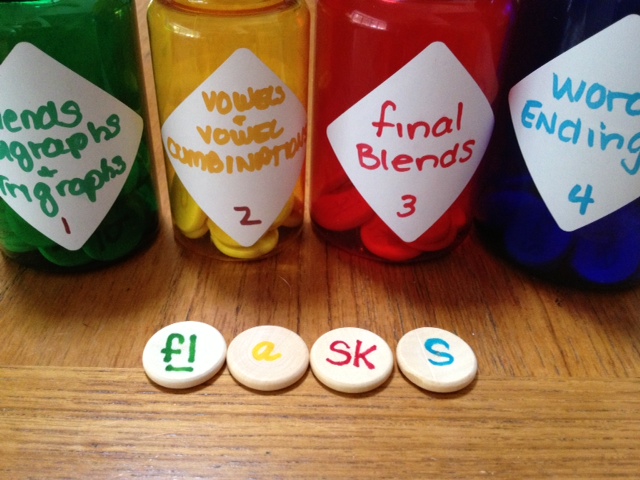
Here is a fun phonemic awareness activity I designed that you can make with old recycled pill or vitamin containers and other common household goods.  It’s a wonderful learning center idea that will help students blend phonics sounds into words.


   1)   Collect and clean old vitamin or pill containers. I like to use the clear, colorful ones.
   2)   Decide upon the playing pieces.  I use a 1 inch hole puncher with thick cardstock, large lima beans, or wooden craft discs. 
   3)   Place consonants, blends, digraphs, word endings or more onto both sides of the playing pieces.  I like to color code the pieces to match the color of the container so that clean up is quick and easy.
   4)   Label the containers as illustrated or as you like.

     How to play (2-4 players):

The object of the game is for players to select “a pill” from each container and try to make a word by blending the sounds.  If a player can make one word or more, they write down the biggest word on a score sheet and collect one point for every letter used in their word.  After each round, the playing pieces are returned to the appropriate container.  Players shake the bottles and then select new pieces.  After ten rounds, the winner is the player with the highest score. 

If you like this game, you will love my newest Reading Games 2 publication.  Come check it out! There, you can also download a full, freebie sample board game! http://goodsensorylearning.com/reading-games.html

Cheers, Erica

Sunday, February 3, 2013

10 Strategies that Transform Passive Learners into Active Learners


Students’ forearms prop heavy heads and eye lids become fatigued and weighty. Information fills the room, but the restless audience remains impervious as attention is stolen by fleeting thoughts and boredom.  If this is a common scene at your school, most likely the learning environment is passive.  Although a passive learning environment can accommodate large numbers of students, it is often an ineffective scholastic milieu.  In contrast, an active learning environment should have the opposite effect on students.  This way of teaching encourages creativity, self directed learning, mindfulness, interaction, discussion and multisensory ways of processing. 

So what can I do to nurture active learning?

1)   Help your students understand the difference between active and passive learning.
2)   Encourage your students to complete the free Passive vs. Active Learning Profile offered free here.
3)   Let your students brainstorm things they can do to become active learners. 
4)   Allow your students to brainstorm things you can do to help them become active learners.
5)   Integrate active learning activities into the classroom such as acting, small group work and hands on activities.
6)   Incorporate fun learning stations in the classroom, so that the students can move around and process with other peers in smaller groups.
7)   Encourage students to preview new topics by watching YouTube clips or doing internet searches so that they come to class with some prior knowledge.
8)   Give students assignment options so that they can make a choice on how they would like to demonstrate their mastery of the content.  Make sure the different options tap into different learning modalities. 
9)   Consider the 12 ways of learning and teach in a multisensory fashion.
10)  Break the class into groups where they take opposing positions on a topic.  Allow one student from each group to facilitate the discussion.  The teacher can act as the judge and can dole out points for good arguments, creative content and clever presentations. 

If you found this blog and activity to be helpful, this is just one of the many resources available in the publication, Planning, Time Management and Organization for Success: Quick and Easy Approaches to Mastering Executive Functioning Skills for Students

Cheers,  Erica
Dr. Erica Warren is the author, illustrator and publisher of multisensory educational materials at Good Sensory Learning and Dyslexia Materials.  She is also the director of Learning to Learn, in Ossining, NY.  To learn more about her products and services, you can go to www.goodsensorylearning.com  www.dyslexiamaterials.com and  www.learningtolearn.biz 

Follow on Bloglovin

Sunday, January 27, 2013

Touch Math Games

Touch Math is a commonly used tactile strategy that helps students to get off their fingers when adding, subtracting and even multiplying.  However, this methodology can be even more enticing for students when this technique is taught and then reinforced through fun kinesthetic games.  

Here are some fun ideas:


  1. Take a foam football and place the numbers and the touch math symbols on it.
  2. Blow up a balloon and cover it with the numbers and touch math symbols.
  3. Write the touch math numbers and symbols on large place mats with a non-skid backing.
  4. If you have access to a playground with a hard flat surface, write the numbers with their touch math symbols on the ground with colorful chalk.  What's even better, let the students do it themselves.  
If you would like free printable touch math strips and you would also like to learn some more strategies, get some specific game ideas and also obtain images of the touch math numbers, touch math strips as well as touch math activities, come check out my newest publication by clicking HERE

Cheers, Erica


Sunday, January 20, 2013

The Difference between a Tutor, Learning Specialist and an Educational Therapist: Choosing Your Best Option


Is your child struggling in school?  Are you considering outside help, but you just don’t know where to start?  Finding the right individual to work with your child is often a difficult task.  What’s more, it’s challenging to determine the type of professional that is required.  To help you with the process, here is a breakdown of the responsibilities and expertise you should expect from these three professions. 

Tutor:
A tutor is a private instructor that has an expertise in a specific school subject.  They teach or re-teach classroom concepts, and they may or may not have formal experience or training in education.  Many offer assistance with homework, and some can offer advice with time management or study skills. 

Learning Specialist:
A learning specialist is a private instructor for students, parents, and teachers.  They focus on metacognitive as well as compensatory learning strategies.  Many also offer instruction, training and remediation in specific academic areas such as reading, writing or math.  A learning specialist should have advanced training and degrees in education and significant coursework, if not degrees in special education, psychology, school psychology, educational psychology, and neuropsychology.  Specific understanding of learning disorders, psycho-educational evaluations, and intervention strategies is paramount.  An expertise in multisensory learning, alternative learning and teaching strategies, self advocacy techniques, and schooling accommodations is a must too.  In addition, they should be versed in assistive technology, software tools, educational websites and apps. 

Educational Therapist
An educational therapist is a private instructor for students and other individuals that wish to improve their mental functioning.  They too offer metacognitive and compensatory learning strategies but also include cognitive remedial training.  This involves strengthening specific areas of cognition that are weak, such as auditory discrimination or visual memory.  Moreover, the educational therapist should be versed in strategies that address social and emotional aspects that impact learning.  Many also have an expertise in working with students who struggle with executive functioning as well as attentional difficulties.  Like the learning specialist, educational therapists have degrees in education and significant coursework, if not a degree, in special education, psychology, school psychology, educational psychology, and neuropsychology.  Specific training in learning disorders, psycho-educational evaluations, and interventions strategies is vital.

What's most important is that you speak with each professional to learn more about their approach and educational training.  If you have any questions, I would love to here your thoughts!

If you are interested in purchasing learning specialist / educational therapist materials, go to: www.goodsensorylearning.com

Cheers,

Erica


Dr. Erica Warren, Learning Specialist and Educational Therapist

Tuesday, January 15, 2013

Motivating Strategies for Reluctant Readers

I just wrote a blog that offers strategies that motivate reluctant readers.  Come check it out on my new community blog (Westchester Professionals for Community Empowerment) that offers free advice from the top professionals in Westchester, New York.  CLICK HERE

Cheers, Erica

Saturday, January 12, 2013

5 Fun Ways to Teach the Vowel Combinations or Vowel Teams


   1)   Place the vowel combinations on a balloon with a permanent marker, or have the students do it themselves.  Pass the balloon from student to student.  They will then say the first vowel combination they see and then they share the sound that it makes.  In a more advanced version, they can share a word that uses that vowel combination.
   2)   If you are looking for something more durable than a balloon, you can purchase playground balls and write the vowel combinations on them.
   3)   Use old scrabble tiles.  Place two tiles together to make a vowel combination and then let the students come up with as many words as they can by adding additional tiles.  Write all the words down that are created into a list for all the students to see.  For added fun, they can add up all the numbers on the tiles to gain points. 
   4)   If you don’t have scrabble tiles, you can purchase small kitchen or bathroom tiles and write the letters on them with permanent markers.  If you get the small, rectangular tiles, they can fit both vowel team letters on one tile.
   5)   Give the students a newspaper or magazine article and a highlighter.  Have them highlight all the vowel combinations they can find.  Then have them write all the words and as a group read the words aloud and discuss what sound the vowel combination makes in each word.

If you are looking for more fun ways to teach the vowel combinations.  Come check out my downloadable workbook, Vowel Combinations Made Easy.  You can even get a free sampling of the publication!  Click Here 

Cheers, Erica